


Scenario Analysis: Where the Iran-Israel War Goes Next
Where Does This End?
The Iran–Israel war has no exit in sight. We map three trajectories and what each one means for the world.
Wars rarely announce their own endings. They ruin, they escalate, they exhaust, and occasionally, almost accidentally, they stop. The conflict now consuming Iran, Israel, and the United States is still in its early phase, yet the strategic contours of where it leads are already visible to anyone willing to read them honestly. The question is not whether this ends, but how and at what cost, let alone to the rest of the world watching from a nervous distance.
To understand the trajectories, it helps to understand the drivers. This war did not begin on 28 February 2026. It began, in a meaningful sense, in 2018, when the US withdrew from the JCPOA[1].. Iran's response was methodical - it began enriching uranium well beyond any civilian threshold. Israel drew its own conclusions. Over the last two years, It has systematically dismantled Iran's proxy architecture across the region, piece by piece. By the time Operation Epic Fury was launched - a joint US-Israel strike timed after markets closed on a Friday, built on the assumption that killing Khamenei would cause the regime to collapse over the weekend - the conditions for exactly this kind of open-ended conflict had been accumulating for years. Underneath the stated rationale of nuclear non-proliferation sat a set of more transactional motivations: the prospect of cheaper oil in a Trump-era economic framework, the utility of an external conflict as a domestic distraction in the United States, and, most dangerously, a degree of hubris that had not been adequately stress-tested against the reality of stress-tested against the reality of Iran's quiet preparations.
The strike succeeded in its tactical objective. It failed in everything else. Khamenei is dead but Iran did not fold. Within days, the regime had elected a new Supreme Leader, reorganised its command structure, and framed the assassination not as a decapitation but as a consecration. A country that was supposed to fracture instead consolidated. The new leadership has every political incentive to prove that Iran's continuity is non-negotiable and every military incentive to demonstrate it.
Iran came into this war better prepared than either Washington or Tel Aviv had accounted for. It has struck US bases across the Gulf, destroyed ammunition depots, targeted energy infrastructure, and moved aggressively against oil production and the Strait of Hormuz. It has compiled and may act upon a list of US-linked corporate targets, in a signal of how far it is willing to expand the theatre. It has demanded, as conditions for any ceasefire, the full withdrawal of US armed forces from the Middle East, an end to all attacks, and economic compensation for decades of sanctions. These are not negotiating positions. They are a statement of maximalist intent from a country that has nothing left to lose from saying the quiet part out loud.
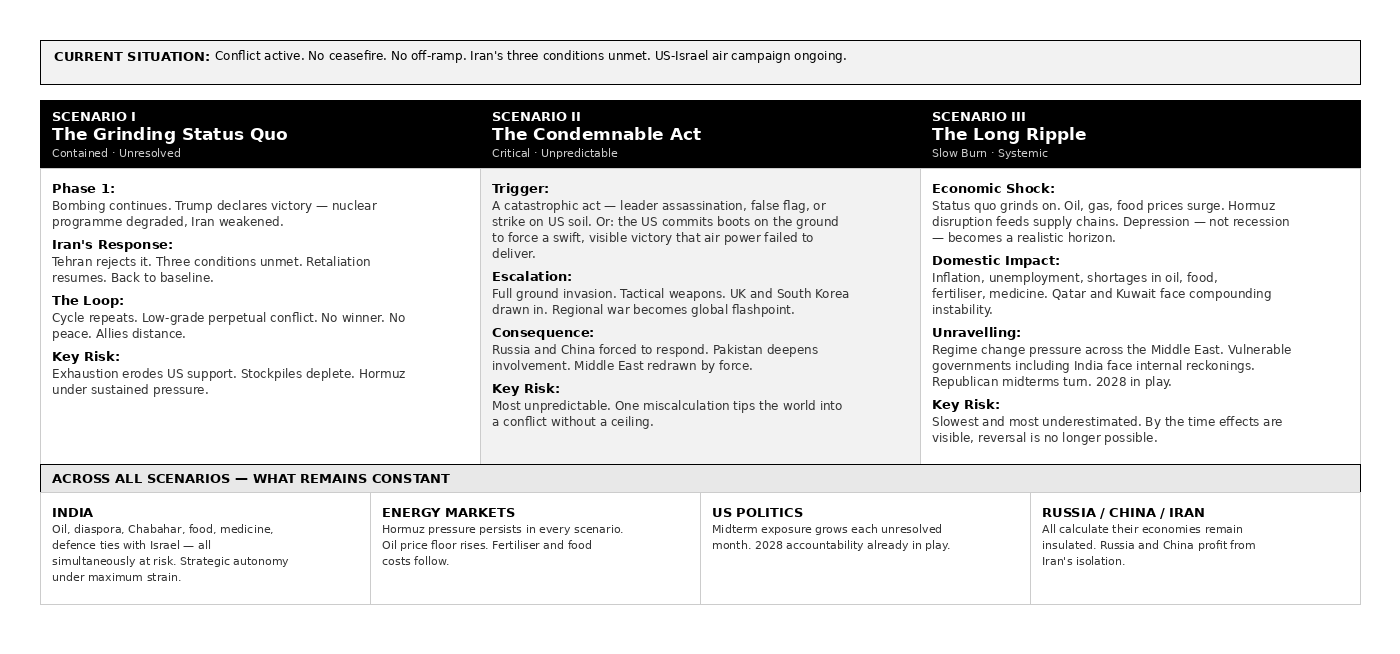
Meanwhile, the US and Israel are not without their own contradictions. Concerns have been raised - and not only from Iran - about false flag operations being conducted against neighbouring countries, designed to widen the coalition of the aggrieved and draw more parties into the conflict. There is no internal consistency in the stated war aims: regime change one day, nuclear degradation the next, ceasefire signals the day after. Allies are distancing. And the broader global audience - including Russia and China, who are watching with the careful attention of parties calculating their windfall - has largely seen through the framing. Our analysis of the current scenario has identified three scenarios that are not predictions but are a map of the terrain.
IMPLICATIONS
Across all three scenarios, certain realities do not change. The Strait of Hormuz remains under pressure. India, which imports a significant share of its oil, gas, and fertiliser from the Gulf, finds itself simultaneously exposed on every front. Strategic autonomy, India's defining foreign policy posture, is being tested not by a binary choice but by a slowly tightening vice. The government's capacity to hold all of these relationships simultaneously, without being forced to choose, will define India's foreign policy credibility for a generation.
The third scenario is the one least discussed and most dangerous. It requires no single catastrophic event. It requires only that the status quo to continue long enough for its economic consequences to become structural. When oil and gas prices rise, food prices follow. When fertiliser prices rise, food costs spike and medicine supply chains fracture and countries like India, already navigating post-COVID and tariff disruptions, will absorb the blow disproportionately. Qatar and Kuwait, already absorbing Iranian missile strikes on their soil, face their own compounding instability. The ripple effect is not dramatic. It is slow, cumulative, and by the time it registers in political terms, it is already too late to reverse.
The political dimension of the third scenario deserves particular attention. Across the Middle East, a number of governments derive their legitimacy from oil revenues and the implicit social contract that prosperity purchases. A prolonged energy crisis disrupts that contract. In countries like Bahrain - a Shia majority governed by a Sunni monarchy, already absorbing Iranian strikes on the American naval base it hosts - the social fabric is being tested in real time. Meanwhile, Russia, China, and Iran's new leadership are all quietly calculating that their core economies remain insulated from the worst of the fallout. That calculation may prove correct. If it does, it represents a profound and lasting shift in the global balance of economic resilience.
In the US , the political arithmetic is beginning to move. A war of choice with no strategic endgame, rising fuel and food prices at home, allies visibly distancing themselves, and ammunition stockpiles under strain is not the profile of a midterm victory. The Republican calculus that launched this operation assumed a swift, legible victory. Each week that passes without one erodes that assumption and deposits the political cost somewhere that will need to be reckoned with, at the latest, in 2028.
None of this means the war ends soon. Wars that create this many compounding interests - military, economic, political, regional - rarely do. What it means is that the world is now living inside a scenario that was entirely foreseeable and almost entirely unprepared for. The weekend war has become something else: a slow, expensive, destabilising reality with no exit in sight and no adult in the room willing to build one. History will have a view on how we got here. The more pressing question is whether the people responsible for getting us here are capable of understanding what it will take to get us out.
Disclaimer - This article is an opinion piece and does not constitute legal, financial, or investment advice.
- [1] The Joint Comprehensive Plan of Action (JCPOA), or Iran nuclear deal, is a 2015 international agreement between Iran and the P5+1 (US, UK, France, China, Russia, plus Germany) designed to limit Iran’s nuclear program in exchange for sanctions relief. It aimed to prevent Iran from developing nuclear weapons.
This article was written by Avanti Bhati, Sukanya Mukherjee, Gopala Goyal and Saral Baheti of Osborne Partners' Business Intelligence and Investigations team.
The Business Intelligence and Investigations team supports clients across the investment lifecycle, from pre-investment due diligence to post-investment investigations and public policy risk assessments, helping them identify and respond to reputational, regulatory and governance risks.
Insights

.png)


Start the conversation
Speak to our team about working with us or find out where we’re speaking next.
Start the conversation
